
Training Day serves as the inaugural day of the annual ECB Simulation Conference for university students, where distinguished representatives from institutions, businesses, and academia share their knowledge and experiences with the participants.
The Training Day for the 9th Conference took place at the Bank of Greece on November 21, 2024.
The key themes of the Conference were:
The 9th Conference was made possible thanks to the invaluable support of the Bank of Greece, the Hellenic Bank Association, Dialectica, Piraeus Bank, Bernitsas Law, and the Athens University of Economics and Business.
Here, we highlight the positions of the speakers during the welcoming speeches. We are greatly honoured to have speakers such as Ms. Charoula Apalagaki, Acting General Manager, Hellenic Bank Association, and Ms. Maria Luís Albuquerque, Commissioner (2024-2029) | Financial Services and the Savings and Investments Union (via a recorded message).
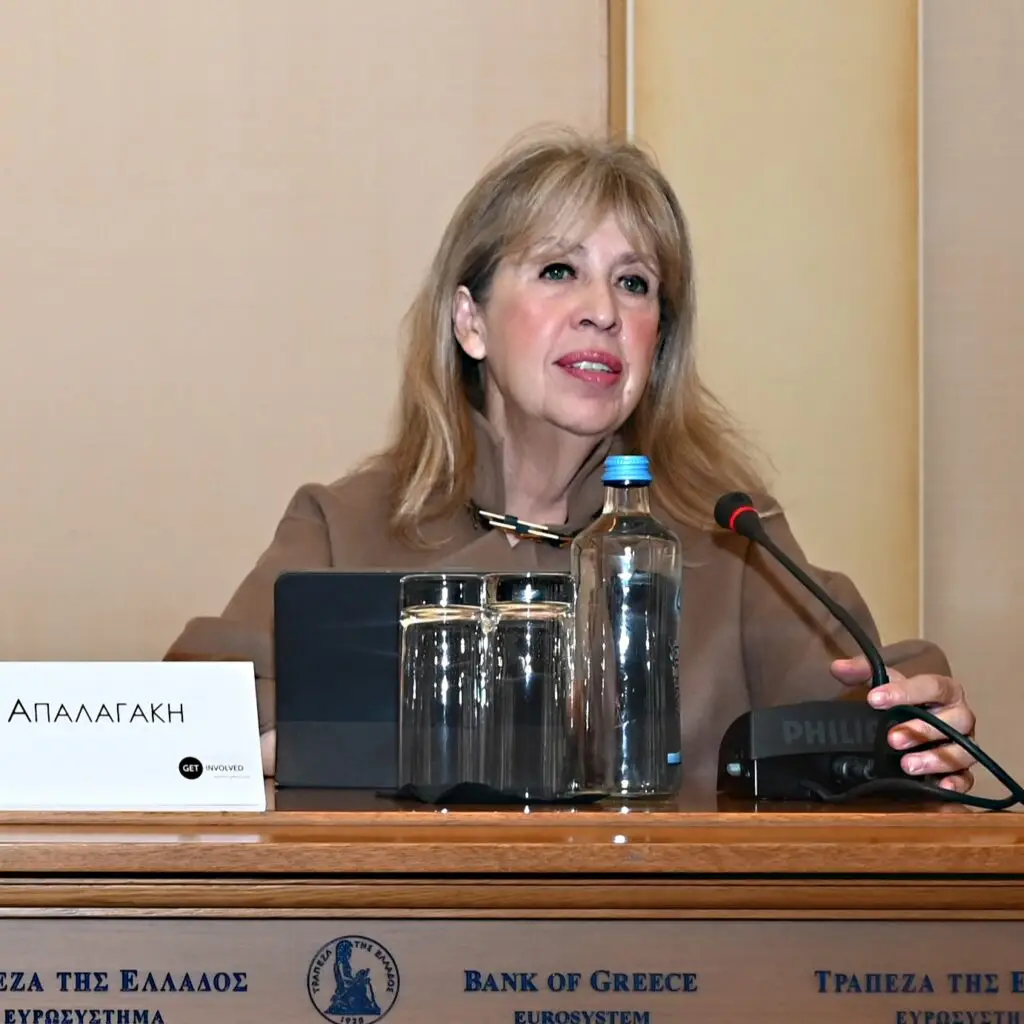
The Training Day opened with a speech by Ms. Haroula Apalagaki, who highlighted the central role of the Hellenic Bank Association, which works closely with the Bank of Greece and contributes to shaping the Greek banking landscape. She emphasized that the Greek banking system now records a historic low in non-performing loans, strong capital adequacy, and robust profitability—factors that place it among the most resilient in the Eurozone.
Ms. Apalagaki focused on the developments that occurred in 2024, a year marked by interest rate cuts, strengthened stability, and significant progress in instant payments, which now dominate transactions.
She continued by underscoring the role of the ECB as the guarantor of monetary stability and a driving force in the green transition of the financial system. In regards the digital euro initiative, she noted that it aims to strengthen Europe’s independence and competitiveness in the payments landscape. Moreover, Ms. Apalagaki stressed the importance of completing the Banking Union and establishing a European Deposit Insurance Scheme.
In closing, she pointed to the Hellenic Bank Association’s role as a bridge between society and the banking sector, aiming at credible public communication and the enhancement of citizens’ financial literacy.
The opening remarks concluded with a recorded message from Ms. Maria Luís Albuquerque, who underlined Europe’s need for more effective capital markets and a higher level of financial literacy, so that savings can be channeled into investments supporting growth, as well as technological and green transitions.
Ms. Albuquerque stressed that every financial decision involves risk, making personal finance skills essential. She referred to the first European strategy for financial literacy, which seeks to build citizens’ trust in investment products. She stressed that the shift from saving to investing must become accessible and low-cost, as is the case in countries with developed investment ecosystems such as Japan and Canada.
She concluded her speech by emphasizing the need for an effective European capital markets ecosystem capable of supporting businesses across Europe and ensuring a more efficient allocation of capital.
